Disclosure: This page contains affiliate links. If you click and buy, we earn a commission at no extra cost to you. As an Amazon Associate we earn from qualifying purchases. Full disclosure →
One room that never quite warms up. A fan heater buzzing away at eleven at night. A bill that jumped after buying the efficient one that turned out not to be. Choosing the wrong electric heater is an easy and expensive mistake.
Start with the fact nobody selling heaters wants to lead with: every one of these converts electricity into heat at essentially the same rate. A 2,000 W oil-filled radiator and a 2,000 W fan heater produce the same heat for the same money. What differs is how that heat is delivered, how quickly you feel it, and how often the thermostat lets the element run. So the real question is not which heater is most efficient. It is which type suits the room and how long you need it warm.
Quick picksWe shortlist products sold in the UK, then analyse verified owner reviews for recurring praise, recurring faults and how products hold up over months of use. Unless a product is marked WHC Tested, we have not used it ourselves.
Read how we choose what to recommend →How the six compare
| Product | Type | Wattage | Room size | Guarantee | Best for |
|---|---|---|---|---|---|
| De'Longhi Dragon 4 | Oil-filled radiator | 2,000 W | Up to 24 m² | 10 years | Steady warmth through an evening |
| Dreo Atom 316 | Ceramic, PTC | 1,500 W | Around 18 m² | – | A small room or home office |
| Dreo 25 Inch | Ceramic tower, oscillating | 1,500 W | 9 to 25 m² | – | Larger or open-plan rooms |
| Pro Breeze Mini Ceramic | Ceramic, oscillating | 2,000 W or 1,200 W | Around 18 m² | – | Fast heat on a budget |
| Warmlite WL44001 | Fan heater | 2,000 W or 1,000 W | Small rooms | 2 years if registered | Occasional use in a tiny room |
| Devola Smart Glass Panel | Panel, wall or floor | 2,000 W | Up to 25 m² | 2 years if registered | Slim permanent installs |
Two columns there are worth pausing on. Several of these run at two power levels, so the lower setting is the one that decides your bill on a mild evening. And the guarantees vary enormously: ten years on the De’Longhi against two on most of the rest, which is each manufacturer telling you how long they expect their own product to last.
1000W to 2000W for 1 hour costs about 26.3p to 52.6p.
Based on 26.32p per kWh. Ofgem price cap for Great Britain, 1 October to 31 December 2026. Checked September 2026.That is the cost while the element is actually on. Any heater with a thermostat cycles off once the room is warm, so a typical evening costs less than the hourly figure multiplied by the hours.
Run flat out for four hours, a 2,000 W heater costs a little over two pounds and a 1,000 W one around half of that. The thermostat is what changes the real figure, because a heater that reaches temperature and switches off is not drawing anything while it coasts. That is the genuine argument for an oil-filled radiator: the oil keeps radiating heat after the element cuts out, so the element spends less time on.
Which type suits your room?
Oil-filled radiators are slow to warm up and hold heat for a long time afterwards. Best for a bedroom or lounge you want comfortable all evening. Silent apart from a faint tick as the metal expands.
Ceramic and PTC heaters heat almost instantly and stop just as fast. Best for a home office, a cold morning, or anywhere you want warmth now rather than in twenty minutes. They move air, so they make some noise.
Panel and glass heaters are slim, often wall-mountable, and suit a living space where a bulky radiator would be in the way. Smart heaters add scheduling on top of any of the above, which saves money only if you actually use it: heating the room for the hour before you walk in beats leaving something running out of habit.
Room size and insulation change all of it. A heater rated for a large room in a new build will feel underpowered in a draughty Victorian terrace and will run for longer to compensate. If damp is part of the problem in that room, see our guide to the best dehumidifiers for small UK homes, because dry air warms faster than damp air.
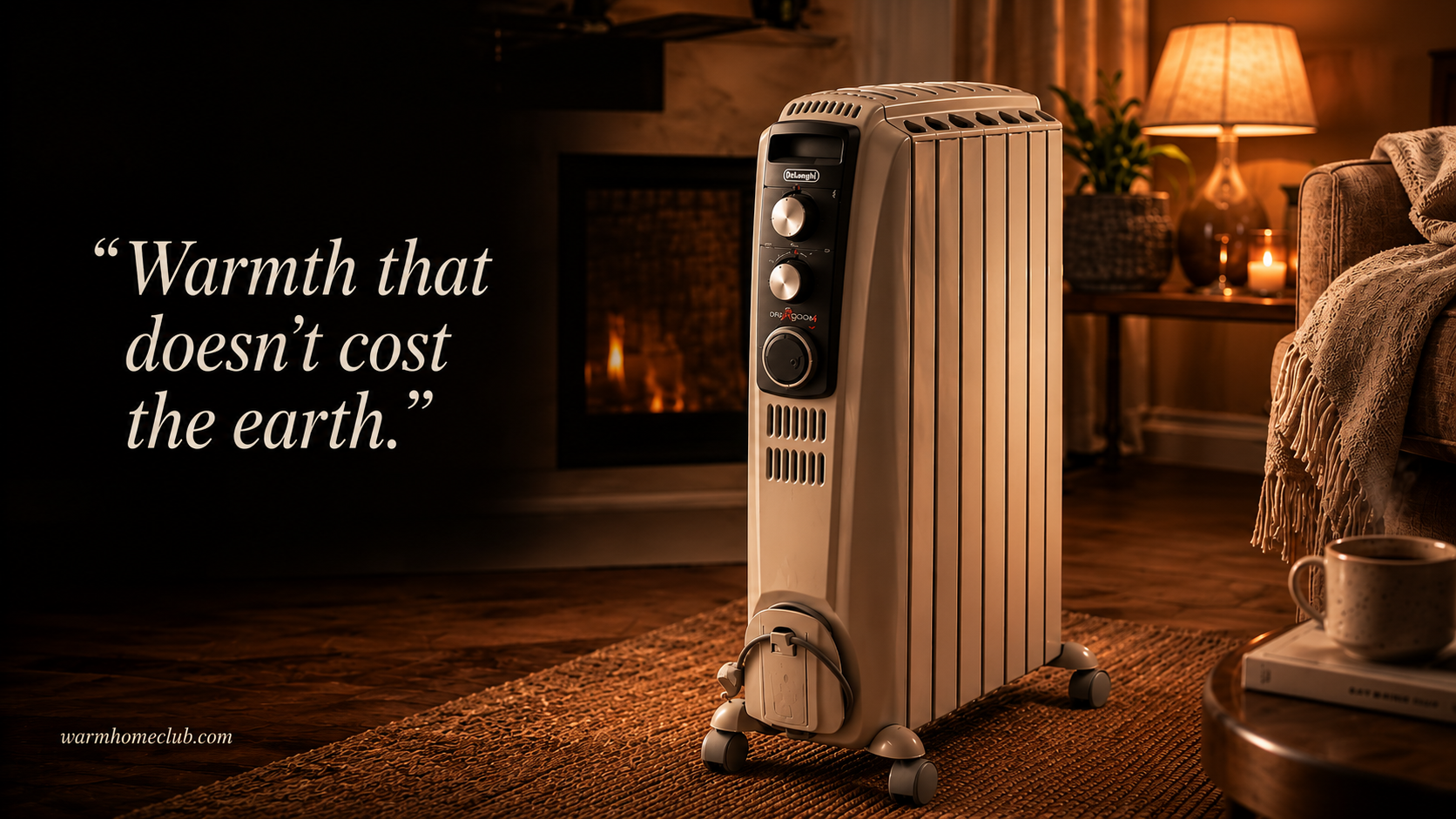
De'Longhi Dragon 4 TRD40820T Oil Filled Radiator
Best for: Steady warmth through an eveningThe best choice if you want one room comfortable for a whole evening rather than a quick blast of heat.
- You want a bedroom or lounge warm for hours
- You would rather not hear a fan
- You can leave it in one place
- You want heat within seconds
- You need to carry it between rooms
- Floor space is tight


- Holds heat after the element cuts out, so it spends less time drawing power
- Owners report it keeping a room at a constant temperature rather than swinging hot and cold
- A built-in timer, so it can warm the room before you use it
- Silent in operation apart from the tick of expanding metal
- A ten year guarantee, by far the longest in this guide
- A 24 hour mechanical timer and an anti-frost setting for unheated rooms
- Wheels and a carry handle, which a 14.8 kg radiator needs
- Looks like a radiator rather than an appliance, which suits a permanent spot
- Slow to warm a cold room compared with anything ceramic
- At 14.8 kg it is heavy, and the wheels only help on hard floors
- Noise divides owners, with some finding the ticking more noticeable than others
- Type
- Oil-filled radiator
- Wattage
- 2,000 W
- Heat settings
- 3
- Room size
- Up to 24 m²
- Timer
- 24 hour mechanical
- Guarantee
- 10 years
- Weight
- 14.8 kg
The slow warm-up is the feature, not the fault. Oil takes time to heat and then gives that heat back gradually, which is why the room stays even and why the element runs less over an evening than a fan heater chasing the same temperature.
The ticking is normal on every oil-filled radiator, not a defect on this one. Metal expands as it heats and contracts as it cools. If you need absolute silence in a bedroom, it is worth knowing before you buy rather than after.
The ten year guarantee deserves more attention than it usually gets. In a category where the cheapest options draw complaints about failing within months, a manufacturer covering a heater for a decade is telling you something no review count can.
Dreo Atom 316 Ceramic Heater
Best for: A small room or home officeThe one to buy for a home office or bedroom you want warm in minutes rather than kept warm all evening.
- You want heat quickly and only while you are in the room
- The heater sits near where you work
- Floor space is limited
- You want a room warm long after it switches off
- The room is large or open-plan
- You want scheduling

- A very large owner review base for a compact heater
- Tip-over detection, overheat protection, flame retardant housing and a child lock
- Warms a small room quickly from cold
- A 12 hour timer, an ECO mode and a fan-only setting for warm days
- Small enough to sit beside a desk without taking floor space
- Rated at 34 decibels, which is why owners call it quiet next to a desk
- At 1,500 W it costs less per hour than the 2,000 W options here
- Best suited to a single small room rather than open-plan space
- The heat stops when it does, unlike an oil-filled radiator
- No app or scheduling, only an on-board timer
- Type
- Ceramic PTC
- Wattage
- 1,500 W
- Room size
- Around 18 m²
- Noise
- 34 dB
- Safety
- Tip-over and overheat protection, child lock
- Extras
- Remote, 12 hour timer, ECO mode
- Weight
- 1.38 kg
The size is the point. A heater that lives beside the desk gets switched on for the two hours you are at the desk, which is the behaviour that actually saves money, rather than warming a whole room all evening for one person.
Owners reporting lower bills after switching are almost certainly reporting that change in habit rather than anything about the heater itself. Running 1,500 W for two hours in place of central heating for the whole house is a real saving, and it is the same saving any 1,500 W heater would give you.
Dreo 25 Inch Ceramic Tower Heater
Best for: Larger or open-plan roomsThe upgrade for a room where a compact heater would be chasing its tail.
- The room is larger than a single bedroom
- You want heat spread rather than aimed
- You will use the remote from a sofa
- The room is small
- You want the cheapest way to warm one corner
- Floor space is tight

- Oscillation spreads heat across a room rather than heating one spot
- Owners report it holding a stable temperature in larger spaces
- A remote in the box, plus four heating modes including ECO
- Rated at 25 decibels, quieter than the compact Dreo despite the size
- The same 1,500 W running cost as the smaller Dreo
- A larger footprint than a compact heater
- Overkill for a single bedroom or a desk
- Costs more than a basic fan heater doing the same wattage
- Type
- Ceramic tower, oscillating
- Wattage
- 1,500 W
- Room size
- 9 to 25 m²
- Oscillation
- 70 degrees
- Noise
- 25 dB
- Safety
- 45 degree tip-over cut-out, overheat protection, child lock
- Height
- 68.5 cm
Oscillation is the meaningful difference here, not power. Both Dreo models draw 1,500 W, so they cost the same to run. This one moves that heat around the room instead of pushing it in one direction, which is what makes a lounge feel evenly warm rather than warm in one chair.
In a genuinely large or open-plan space, be realistic. No 1,500 W heater will heat an open ground floor. It will make the part of the room you are sitting in comfortable, which is usually what you actually wanted.
Pro Breeze Mini Ceramic Heater
Best for: Fast heat on a budgetThe budget choice for fast heat, as long as you use the thermostat rather than leaving it on full.
- You want ceramic heat without paying mid-range prices
- The room is small
- You will set the thermostat and leave it
- Silence matters
- You want a remote or scheduling
- You want the lowest hourly running cost

- Two power settings, so the 1,200 W low setting costs a quarter less per hour than full power
- 60 degree oscillation, which most compact heaters at this price do not offer
- Fast ceramic heat at the lowest mid-range price here
- Compact enough not to dominate a small room
- An adjustable thermostat, which is what keeps the running cost down
- Owners report it heating a room quickly from cold
- A genuinely cheap way to heat one occupied room instead of the house
- At 2,000 W it costs more per hour on full power than either Dreo
- Noise divides owners, with some finding it louder than expected
- No timer, unlike both Dreo models
- No quoted noise rating, unlike the Dreos
- Type
- Ceramic, oscillating
- Wattage
- 2,000 W high, 1,200 W low
- Room size
- Around 18 m²
- Oscillation
- 60 degrees
- Safety
- Overheat protection and anti tip-over
- Weight
- 2.26 kg
The 2,000 W rating is worth understanding rather than fearing. It costs more per hour than the 1,500 W Dreos while the element is on, but it also reaches temperature sooner, and once the thermostat cuts in the difference over an evening is smaller than the headline numbers suggest.
What matters more is whether you use the low setting and the thermostat. On 1,200 W it costs about 32p an hour rather than 53p, and in a small room that is usually plenty. Left on full with no thermostat, it is the most expensive thing here to run.
Warmlite WL44001 Thermo Fan Heater
Best for: Occasional use in a tiny roomFine as an occasional heater in a small space. Not the one to buy if it will run every evening all winter.
- You need something cheap for occasional use
- The space is small, such as a caravan or workshop
- Lowest hourly cost matters most
- It will be your main source of heat
- You want it to last several winters
- You need quiet

- A 1,000 W low setting, the cheapest per hour of anything here
- BEAB and GS safety approved, which not every budget heater is
- A cool setting, so it works as a fan in summer
- The lowest price of anything in this guide
- Small enough for a tiny room, a caravan or a workshop
- Heats quickly for its size
- A large owner review base for a budget heater
- A second year of guarantee if you register it online
- A number of owners report units failing after around two months
- Heat output divides owners, with some finding it weak
- Noise divides owners too, as fan heaters generally do
- Nothing is retained, so the room cools the moment it stops
- Type
- Fan heater
- Wattage
- 2,000 W high, 1,000 W low
- Heat settings
- Cool, warm, hot
- Safety
- Overheat protection, BEAB and GS approved
- Guarantee
- 1 year, 2 if registered online
- Weight
- 1.14 kg
The low setting is the reason to buy it. At 1,000 W it draws half what a 2,000 W heater does, roughly 26p an hour, and in a small space that is often enough. Run it on 2,000 W and it costs the same as everything else here. The catch either way is that a fan heater retains nothing, so the warmth goes the moment it stops.
The failure reports at around two months are the reason it sits here rather than higher. At this price that may be an acceptable trade for occasional use, but as an every-evening heater it is the wrong buy, and buying two of them costs more than buying one of almost anything else in this guide.
Devola 2000W Smart Electric Glass Panel Heater
Best for: Slim permanent installsWorth it if you will genuinely use the scheduling. As a heater alone, cheaper options produce the same warmth.
- You want the room warm before you walk in
- Floor space is at a premium
- The heater will stay in one room permanently
- You would not set up a schedule
- Your WiFi is patchy in that room
- You want to move it between rooms

- Scheduling means the room is warm when you arrive rather than heated all evening
- Slim and wall-mountable, so it takes no floor space
- Owners describe it looking like part of the room rather than an appliance
- Owners report using it in place of central heating for one room overnight
- IP24 rated, so it can be used in a bathroom, which nothing else here can
- Wall brackets and floor feet both included, so it works either way
- A thermostat accurate to half a degree, which keeps the element off more of the time
- Works with Alexa and Google as well as its own app
- WiFi connectivity divides owners, with some reporting repeated connection problems
- Noise divides owners, with some finding it louder than expected
- A smaller owner review base than the portable heaters here
- At 2,000 W it is among the more expensive here to run on full power
- Type
- Panel, wall-mounted or freestanding
- Wattage
- 2,000 W
- Room size
- Up to 25 m²
- Rating
- IP24, safe for bathrooms
- Controls
- App, Alexa, Google, 24 hour timer, remote
- Guarantee
- 1 year, 2 if registered within 14 days
Scheduling is the entire argument for this one, and it only pays if you use it. Heating a bedroom for forty minutes before bed costs a fraction of leaving something on through the evening, and that difference is where the money is, not in the panel itself.
The connectivity complaints have a specific cause worth knowing before you blame the heater. It joins 2.4 GHz networks only, so on a router broadcasting both bands under one name you need to split them, or temporarily disable 5 GHz, to get through setup. Plenty of the one-star reviews about the app describe exactly that problem.
Which heater should you buy?
For a bedroom or lounge you want comfortable all evening, buy the De’Longhi Dragon 4. For a home office or any room you want warm in minutes and only while you are in it, the Dreo Atom 316 is the better fit, and the Dreo 25 Inch is the version for a larger room.
On a budget, the Pro Breeze Mini gives you fast ceramic heat, and the Warmlite is the cheapest way to warm a tiny space occasionally, with the reliability caveat that comes with it.
And if you want the room warm before you walk into it, the Devola is the only pick here that can do that.
Check the De'Longhi Dragon 4 on Amazon
Electric heater buying guide: your questions answered
Which electric heater is cheapest to run?
The one with the lowest wattage that still warms your room properly. Every electric heater in this guide converts electricity to heat at essentially the same rate, so a 1,000 W heater costs about half as much per hour as a 2,000 W one, whatever type it is. At the October 2026 price cap rate of 26.32p per kWh, that is roughly 26p an hour against 53p. The catch is that an underpowered heater running constantly can cost more than a higher-wattage one that reaches temperature and switches off, so match the heater to the room rather than simply picking the lowest number.
How much does it cost to run an electric heater?
Multiply the wattage by the hours and by your unit rate. At the October 2026 price cap rate of 26.32p per kWh, a 1,000 W heater costs about 26p an hour, a 1,500 W heater about 40p, and a 2,000 W heater about 53p. Those figures are for the element actually running. Any heater with a thermostat cycles off once the room is warm, so a typical evening costs less than the hourly figure multiplied by the hours. Check the rate on your own bill, because tariffs differ and the cap changes quarterly.
Are oil-filled radiators more efficient than fan heaters?
Not in the way the marketing suggests. All of these heaters turn electricity into heat at essentially 100 percent, so a 2,000 W oil-filled radiator and a 2,000 W fan heater produce the same heat for the same money. The difference is in delivery. An oil-filled radiator stores heat and keeps radiating it after the element cuts out, so over a long evening the element spends less time drawing power. A fan heater gives you warmth immediately and stops the moment you switch it off. Neither is more efficient, but one suits hours of background warmth and the other suits twenty minutes of it.
Is it cheaper to run an electric heater than central heating?
For one occupied room, usually yes. Warming a single room with a 1,500 W heater for an evening costs less than firing the boiler to heat a whole house, particularly in a flat where only one or two rooms are in use. Central heating works out better when several rooms need warmth at once, or in a poorly insulated house where an electric heater would run constantly to keep up. The saving comes from heating less of the house, not from the heater being clever.
What size heater do I need for a small UK bedroom?
A compact ceramic heater around 1,500 W is usually enough for a standard UK bedroom, and an oil-filled radiator suits the same room if you want it comfortable for hours rather than minutes. For a larger lounge or open-plan space, look for oscillation to spread the heat rather than simply a higher wattage. Insulation matters as much as square footage: the same heater that copes in a new build will run far longer in a draughty older house.
How can I make my electric heater cheaper to run?
Use the thermostat so the element switches off once the room is warm, rather than running it on full. Use a timer or schedule so it only runs when the room is occupied. Shut the door and close curtains to keep the heat in, and use draught excluders on ill-fitting doors and windows. Heat the room you are in rather than the house, and switch the heater off when you leave rather than keeping it ticking over out of habit. Those habits save more than any difference between the models in this guide.
Are electric heaters safe to leave on unattended?
Treat them as appliances you supervise rather than leave running. Stand a heater on a level surface, keep it clear of curtains, bedding and furniture, and never cover it or use it to dry clothes. Look for tip-over protection and overheat cut-out, which most current models include, and use the timer rather than leaving a heater running overnight. Plug it straight into a wall socket rather than an extension lead, since heaters draw a lot of current, and stop using any heater with a damaged cable or plug.
Found this guide useful?
New buying guides, comparison updates, and the occasional deal worth knowing about. One email a week.
Last updated: . Prices correct at time of publishing and subject to change.