Disclosure: This page contains affiliate links. If you click and buy, we earn a commission at no extra cost to you. As an Amazon Associate we earn from qualifying purchases. Full disclosure →
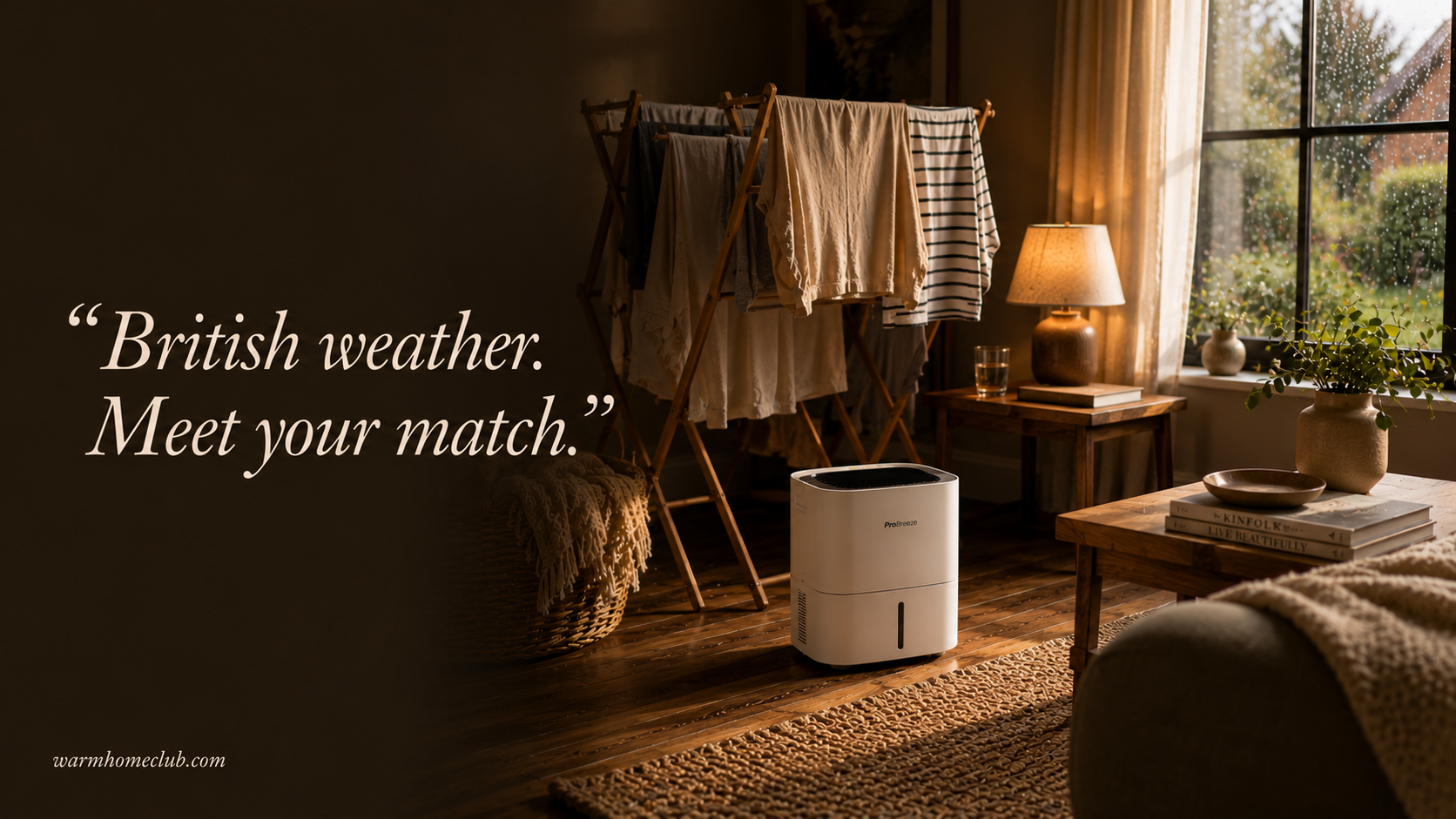
Condensation running down the inside of the windows every morning. Washing that takes three days to dry on an airer. A musty smell in the wardrobe you can never quite place. These are not separate problems. They are the same one: too much moisture in the air, and nowhere for it to go.
The decision that matters is scale, not brand. A wardrobe needs a passive tub. A bedroom with wet windows needs an electric dehumidifier. A whole flat drying washing indoors needs a proper compressor unit with real daily capacity. Buy for the wrong scale and even a well-reviewed machine will disappoint.
Quick picksWe shortlist products sold in the UK, then analyse verified owner reviews for recurring praise, recurring faults and how products hold up over months of use. Unless a product is marked WHC Tested, we have not used it ourselves.
Read how we choose what to recommend →How the six compare
| Product | Type | Daily capacity | Power | Best for |
|---|---|---|---|---|
| Pro Breeze 12L/Day | Compressor dehumidifier | Up to 12 litres | 200 W | Flats, condensation and indoor drying |
| Pro Breeze 20L/Day | Compressor dehumidifier | Up to 20 litres | 450 W | Larger rooms and persistent damp |
| EcoAir DD1 Desiccant | Desiccant dehumidifier | Up to 7.5 litres | 300 W | Cold rooms, garages and conservatories |
| EasyAcc 1200ml Mini | Peltier mini dehumidifier | Up to 0.4 litres | Around 33 W | A bathroom or box room |
| ANSIO 10 Pack | Disposable calcium chloride tubs | Passive | None | Wardrobes and cupboards |
| Nyxi Hanging Bags, 6 Pack | Hanging absorber bags | Passive | None | Inside wardrobes, among clothes |
The capacity column is the one to read carefully. A 12 litre unit can pull up to twelve litres of water from the air in a day. The EasyAcc mini is sold on its 1,200 ml tank, but it removes up to 0.4 litres a day, and that figure is measured at 30 degrees and 80 percent humidity, which is far warmer and wetter than a UK bathroom. In real use the gap between the two is roughly thirty to one. The passive tubs work slower still, which is exactly right for a wardrobe and nowhere near enough for a room.
What size do you actually need?
Passive tubs suit wardrobes, cupboards and windowsills with a mild musty smell or light condensation. No power, no noise, and they quietly fill with water over weeks.
Mini electric units suit a single small enclosed room, such as a bathroom, box room or caravan, where a tub is not keeping up but a full dehumidifier would be overkill. They will not dry a room of washing.
10 to 12 litres a day is the standard for most UK flats and bedrooms: it handles everyday condensation and indoor laundry without dominating the room. 20 litres and above is for larger rooms, open-plan spaces, or damp that keeps coming back however often you run a smaller unit.
Running cost is lower than most people expect, because a compressor dehumidifier draws a fraction of what a heater or tumble dryer does.
200W for 8 hours costs about 42.1p.
Based on 26.32p per kWh. Ofgem price cap for Great Britain, 1 October to 31 December 2026. Checked September 2026.Based on the 200 W Pro Breeze 12L. With the humidity sensor switching it off once the room reaches its target, a typical day costs less than this.
That is the real argument against drying washing with a heated tumble dryer, which typically draws around ten times the power for the hour or two it runs. If the room is also cold, see our guide to the best electric heaters UK, since warmer air holds moisture in a way the dehumidifier can then remove more efficiently.
Cold rooms need a different kind of dehumidifier. Compressor units, including both Pro Breezes here, work by chilling a coil so moisture condenses on it. In a room below roughly 15 degrees, that coil ices up and performance drops sharply. A desiccant dehumidifier absorbs moisture into a material instead, so it keeps working in the cold, and gives off gently warmed air as it does. If the damp is in a conservatory, a garage, a caravan or a bedroom you keep cool, that is the type to buy.
Which one for which room
Bedroom. The Pro Breeze 12L for wet windows in a normal bedroom, run in sleep mode overnight. For a small box room, the EasyAcc is enough. If the room is kept cold, the EcoAir will do more than either.
Bathroom. Check the extractor fan works and use it first, because no dehumidifier keeps up with a daily shower on its own. For a bathroom without a working fan, the EasyAcc handles the lingering damp between showers.
Kitchen. Lids on pans and the cooker hood on come first. If condensation still forms on the windows, the Pro Breeze 12L deals with the rest.
Drying washing indoors. The Pro Breeze 12L in continuous mode for an airer in a small room, or the Pro Breeze 20L with its laundry mode for regular full loads. In a cold utility room or garage, the EcoAir, which owners report drying a full clothes horse in under four hours.
Wardrobes. Nyxi hanging bags on the rail among the clothes, with an ANSIO tub on the floor if the wardrobe is against a cold outside wall.
Cupboards and under the stairs. ANSIO tubs. If one fills within a week or two, the space needs more than a tub.
Conservatory, garage or caravan. The EcoAir desiccant. These are the cold spaces where a compressor unit loses most of its performance.
A whole flat with damp that keeps coming back. The Pro Breeze 20L, moved to whichever room is worst that week. If the damp still returns, look for a cause such as a leak, rising damp or blocked ventilation before buying anything bigger.
Pro Breeze 12L/Day Dehumidifier
Best for: Flats, condensation and indoor dryingThe one most UK flats should start with. Enough capacity to make a visible difference, without being an appliance you have to find a permanent home for.
- You have wet windows or slow-drying washing
- You live in a flat or a small house
- You want it to run overnight
- The damp is across a large house
- You only have a musty wardrobe
- Floor space is very tight


- The right capacity for most UK flats and bedrooms
- Pro Breeze says it won a Which? Best Buy for dehumidifiers in 2025
- An automatic humidity sensor switches it off once the room reaches its target
- Continuous mode for drying washing, and sleep mode and a 24 hour timer for overnight use
- Under 38 dB, quiet for a compressor unit
- A drainage hose and four wheels, so it can run unattended and move between rooms
- Bigger than the mini units, so it needs floor space
- A 1.8 litre tank needs emptying often when drying washing, unless you use the hose
- Not enough for a whole house with serious damp
- Like any compressor unit, it loses much of its performance in rooms below about 15 degrees
- Type
- Compressor
- Capacity
- Up to 12 litres a day
- Tank
- 1.8 litres, plus drainage hose
- Power
- 200 W
- Noise
- Under 38 dB
- Controls
- Humidity sensor, 30 to 80 percent
- Modes
- Auto, continuous, sleep
- Weight
- 4.76 kg, on wheels
The humidity sensor is the feature that decides the running cost. A dehumidifier that stops at, say, 50 percent humidity spends much of the day switched off, and one that runs flat out regardless is burning money pulling moisture out of air that is already dry enough. A cheap hygrometer in each problem room tells you where the damp actually is before you decide where the dehumidifier should live. The TempPro TP49 comes as a pack of three and shows a simple dry, comfortable or wet indicator, which is all you need to find the worst room.
See the TempPro TP49 hygrometer (formerly ThermoPro), pack of three
For washing, use continuous mode rather than auto, which would switch off once the room itself reached its target. Put the airer right next to it rather than across the room, since it works on the air immediately around it: the closer the wet clothes, the faster they dry.
Pro Breeze 20L/Day Dehumidifier
Best for: Larger rooms and persistent dampThe step up for damp the 12L cannot keep up with. Same brand, same controls, nearly double the capacity.
- The room is large or open-plan
- The damp keeps coming back however often you run a smaller unit
- You dry a lot of washing indoors
- It is for a single bedroom
- You live in a small flat
- Floor space is tight

- Close to double the daily capacity of the 12L top pick
- A dedicated laundry drying mode, which the 12L does not have
- A 5.5 litre tank, three times the 12L, plus a drainage hose for continuous running
- Auto defrost, which keeps it working in a cold garage or unheated room
- Child lock, sleep display and a 24 hour timer
- A large owner review base, comparable to the 12L
- At 450 W it costs more than twice as much to run as the 12L, about 95p for eight hours
- At 12.2 kg it is more than twice the weight, and 58 cm tall
- More capacity than a single bedroom or small flat needs
- Type
- Compressor
- Capacity
- Up to 20 litres a day
- Tank
- 5.5 litres, plus drainage hose
- Power
- 450 W
- Room size
- Around 30 m²
- Controls
- Humidity sensor, 30 to 80 percent
- Modes
- Four, including laundry drying
- Weight
- 12.2 kg, on wheels
The laundry mode is the real difference from the 12L, not just the capacity. It runs the compressor flat out regardless of room humidity, which is what drying a full airer needs, whereas a humidity sensor would switch off once the room itself felt dry enough and leave the clothes damp.
Be honest with yourself about whether you need it. Nearly double the capacity costs more than double the power: at 450 W it runs to about 95p for eight hours against 42p for the 12L. Most small homes are well served by 12 litres a day, and the 20L only earns its place if the smaller unit genuinely cannot keep up. If you are unsure, start with the 12L, because within a fortnight you will know whether it is coping.
EcoAir DD1 Simple MK3 Desiccant Dehumidifier
Best for: Cold rooms, garages and conservatoriesThe one to buy for cold spaces: conservatories, garages, caravans, and bedrooms in homes where the heating is kept low.
- The damp is in a room that stays cold
- You want to dry washing in a garage or utility room
- You would like the room a little warmer too
- The room is heated and warm
- You want the lowest running cost for a warm room
- You want a digital humidity readout

- Keeps working in cold rooms, where compressor dehumidifiers lose much of their performance
- Gives off gently warmed air, a small bonus in a cold space
- Owners report it drying a full clothes horse in under four hours
- 34 dBA, quiet for a dehumidifier
- The antibacterial filter slides out for cleaning
- Light at 6 kg, so it moves easily between a garage and the house
- Owner experience on reliability is split, with some units lasting seven years and others stopping after around eight months
- At 300 W it uses more power than the 12L Pro Breeze, for less daily capacity in a warm room
- A manual dial with no digital humidity display
- Type
- Desiccant
- Capacity
- Up to 7.5 litres a day
- Power
- 300 W
- Noise
- 34 dBA
- Controls
- Rotary dial, 2 speeds
- Filter
- Silver nano antibacterial, removable
- Weight
- 6 kg
- Guarantee
- 2 years
The warm air is not a side effect worth ignoring. A desiccant unit heats its moisture-absorbing wheel to release the water it has collected, and some of that heat comes out into the room. In a heated living room that is wasted. In a cold conservatory or a bedroom you are trying not to heat, it is part of the point.
Running cost depends on where you use it. At 300 W it costs about 63p for eight hours, more than the 12L Pro Breeze. In a warm room the compressor unit removes more water for less money. In a cold one, the desiccant is the one that is actually removing water at all, which makes the comparison irrelevant.
EasyAcc 1200ml Electric Mini Dehumidifier
Best for: A bathroom or box roomThe right answer for one small room where tubs are not enough and a full dehumidifier would be overkill.
- The problem is one small enclosed room
- Passive tubs are not keeping up
- You want something electric but small
- You want to dry washing
- The room is a normal-sized bedroom
- Noise overnight would bother you

- Compact enough for a bathroom shelf or box room
- A step up from passive tubs when they are not keeping up
- Under 35 dB, quiet enough for a bedside table
- Uses under a kilowatt hour a day, around 21p at the current cap rate
- Good value next to repeatedly replacing tubs
- A colour-changing light owners like
- Removes up to 0.4 litres a day in test conditions and less in a cool UK room, around thirty times less than the Pro Breeze
- Noise divides owners, with some describing it as noisy
- Will not dry washing or deal with a whole room of condensation
- Type
- Peltier mini dehumidifier
- Extraction
- Up to 0.4 litres a day, at 30°C and 80% humidity
- Tank
- 1,200 ml, auto shut-off when full
- Power
- About 0.79 kWh per day
- Noise
- Under 35 dB
Be realistic about what a mini unit does. Peltier units cool a small plate rather than running a compressor, which is why they are quiet and cheap to run, and why they extract so little. At up to 0.4 litres a day in warm test conditions, it is closer in scale to a very active moisture tub than to the Pro Breeze above.
Where it earns its place is a small, closed room with a persistent problem: a bathroom without a good extractor, a box room against a cold outside wall, a caravan through winter. In those spaces it does more than tubs and costs far less to run than anything larger.
ANSIO Disposable Moisture Absorber, Pack of 10
Best for: Wardrobes and cupboardsThe lowest-risk way to deal with musty cupboards and wardrobes. Not a fix for a damp room.
- The problem is wardrobes, cupboards or windowsills
- You want to cover several spots at once
- You do not want another appliance
- You have condensation across a room
- You need to dry washing
- You would rather not keep buying refills

- An enormous owner review base for any moisture product
- Ten tubs, so several cupboards and wardrobes are covered at once
- No power, no noise and nothing to switch on
- Owners consistently praise it for musty cupboards
- Easy to set up and empty
- Water collected varies widely, depending on how damp the space really is
- Passive only, so no substitute for an electric unit in a damp room
- Disposable, so there is an ongoing replacement cost
- Type
- Disposable calcium chloride tubs
- Quantity
- 10
- Capacity
- 230 ml per tub
- Absorbs
- Up to three times its own weight
- First water
- Within 1 to 3 weeks
The split in owner feedback, some tubs filling up and others collecting nothing, is almost certainly the spaces rather than the product. A tub in a genuinely damp cupboard fills visibly. The same tub in a spare room with a mild smell barely changes, because there is not much moisture to take.
That makes them a useful diagnostic as well as a fix. ANSIO says the first water appears within one to three weeks depending on humidity. If a tub fills well inside that, the space has a real moisture problem and may need more than a tub. If there is still nothing after three weeks, whatever you are smelling is probably not damp.
Nyxi Hanging Wardrobe Dehumidifier Bags, Pack of 6
Best for: Inside wardrobes, among clothesThe right format for inside a wardrobe. Use it alongside a floor tub rather than instead of one.
- Clothes smell musty or feel damp
- The wardrobe is against an outside wall
- You want something that takes no floor space
- The problem is a whole room
- You do not want to keep buying replacements
- The wardrobe is packed tight, with no gap to hang a bag

- Hangs on the rail among the clothes, which is where moisture does the damage
- Six bags, enough for several wardrobes
- Slim, so it takes no floor or shelf space
- Nyxi offers a refund if no water collects within three to five days
- A large owner review base
- Bags need replacing every couple of months, so there is an ongoing cost
- The collected water stays in the bag, so check it when it gets heavy, since a damaged bag can drip onto clothes
- Much smaller per unit than a floor tub
- Type
- Hanging absorber bags
- Quantity
- 6
- Size
- 230 g each
- Lasts
- Up to 60 days
- Power
- None
Where the absorber sits matters more than its size. A tub on the wardrobe floor deals with the air at the bottom, while the clothes hanging above it are where musty smells and mildew actually show. Hanging a bag among them puts it where the problem is.
Keep a gap around each bag rather than pressing it between tightly packed clothes. Air needs to reach it to work, and a bag squashed against fabric is the one most likely to leave a damp mark if it is damaged.
Which should you buy?
For wet windows and washing that will not dry in a flat or small house, buy the Pro Breeze 12L. For a larger space or damp that keeps coming back, the Pro Breeze 20L is the same machine with nearly double the capacity, and a laundry mode for drying washing.
For one small room where tubs are not enough, the EasyAcc Mini fills the gap. For a cold conservatory, garage or bedroom, the EcoAir desiccant keeps working where the others struggle. And for wardrobes and cupboards, Nyxi hanging bags among the clothes and ANSIO tubs on the floor cover it without a socket in sight.
Check the Pro Breeze 12L on Amazon
Dehumidifier buying guide: your questions answered
What does a dehumidifier's litre rating actually mean?
It is the maximum amount of water the unit can remove from the air in 24 hours under standard test conditions, which are usually warmer and more humid than a typical UK room. A 12 litre unit can remove up to 12 litres a day, but in a cool bedroom it will remove less. Do not confuse it with tank size: the mini unit in this guide has a 1,200 ml tank but removes up to 0.4 litres a day, and that is in warm test conditions. As a rough guide, 10 to 12 litres covers a flat or bedroom with everyday condensation and indoor drying, and 20 litres and above suits larger rooms or persistent damp.
Should I buy a compressor or a desiccant dehumidifier?
It depends on how warm the room is. Compressor dehumidifiers chill a coil so moisture condenses on it, which is efficient in a heated room but loses much of its performance below roughly 15 degrees, when the coil starts to ice up. Desiccant dehumidifiers absorb moisture into a material instead, so they keep working in the cold, and they give off gently warmed air. For a heated bedroom or living room, a compressor unit is cheaper to run. For a conservatory, garage, caravan or a room you keep cool, a desiccant is the one that will actually work.
Do I need a dehumidifier or will moisture absorber tubs be enough?
It depends on the scale. Tubs suit a wardrobe, cupboard or windowsill with a mild musty smell. If you have condensation running down windows, damp patches on walls, or washing drying indoors, you need an electric dehumidifier, because tubs cannot keep up with that volume of moisture. A useful test: put a tub in the space for a fortnight. If it fills noticeably, the space has a real moisture problem and may need more than a tub.
Are dehumidifiers expensive to run?
Less than most people expect. A compact compressor dehumidifier like the Pro Breeze 12L draws around 200 W, which works out at just over 5p an hour at the October 2026 price cap rate of 26.32p per kWh, or roughly 42p for eight hours. A mini Peltier unit uses less still, around 21p a day, but removes a small fraction of the water. With a humidity sensor switching it off once the room is dry enough, a typical day costs less than that. A heated tumble dryer draws roughly ten times the power, which is why a dehumidifier is the cheaper way to dry washing indoors.
Can a dehumidifier get rid of mould?
No, it prevents it rather than removing it. A dehumidifier lowers the moisture that mould needs to grow and spread, which makes it an effective prevention tool. Existing mould has to be cleaned off directly with a suitable treatment. After that, keeping the room’s humidity down stops it coming back. If mould keeps returning despite a dehumidifier, the cause may be a leak, rising damp or poor ventilation, which is worth having looked at.
What humidity should I aim for at home?
Somewhere around 40 to 60 percent suits most UK homes. Above that, condensation and mould become more likely. Well below it, the air starts to feel dry, particularly with central heating running. A dehumidifier with a humidity sensor lets you set a target and switches off once the room reaches it, which is both more comfortable and cheaper than running it constantly.
Where should I put a dehumidifier?
In the middle of the room rather than pushed into a corner, with around 15 to 20 cm of clear space on every side so air can move freely in and out. When drying washing, put the airer right next to it, since it works on the air immediately around it. Keep it away from open windows and external doors, where it would be pulling in outside air rather than dealing with the room.
What is the difference between a dehumidifier and a humidifier?
They do opposite jobs. A dehumidifier removes moisture and is the answer to condensation, damp, musty smells and drying washing indoors. A humidifier adds moisture back to air that has become too dry, usually from central heating in winter. A humidifier will make damp and mould worse, and a dehumidifier in already dry air will make it drier still, so match the appliance to the problem you actually have.
Found this guide useful?
New buying guides, comparison updates, and the occasional deal worth knowing about. One email a week.
Last updated: . Prices correct at time of publishing and subject to change.