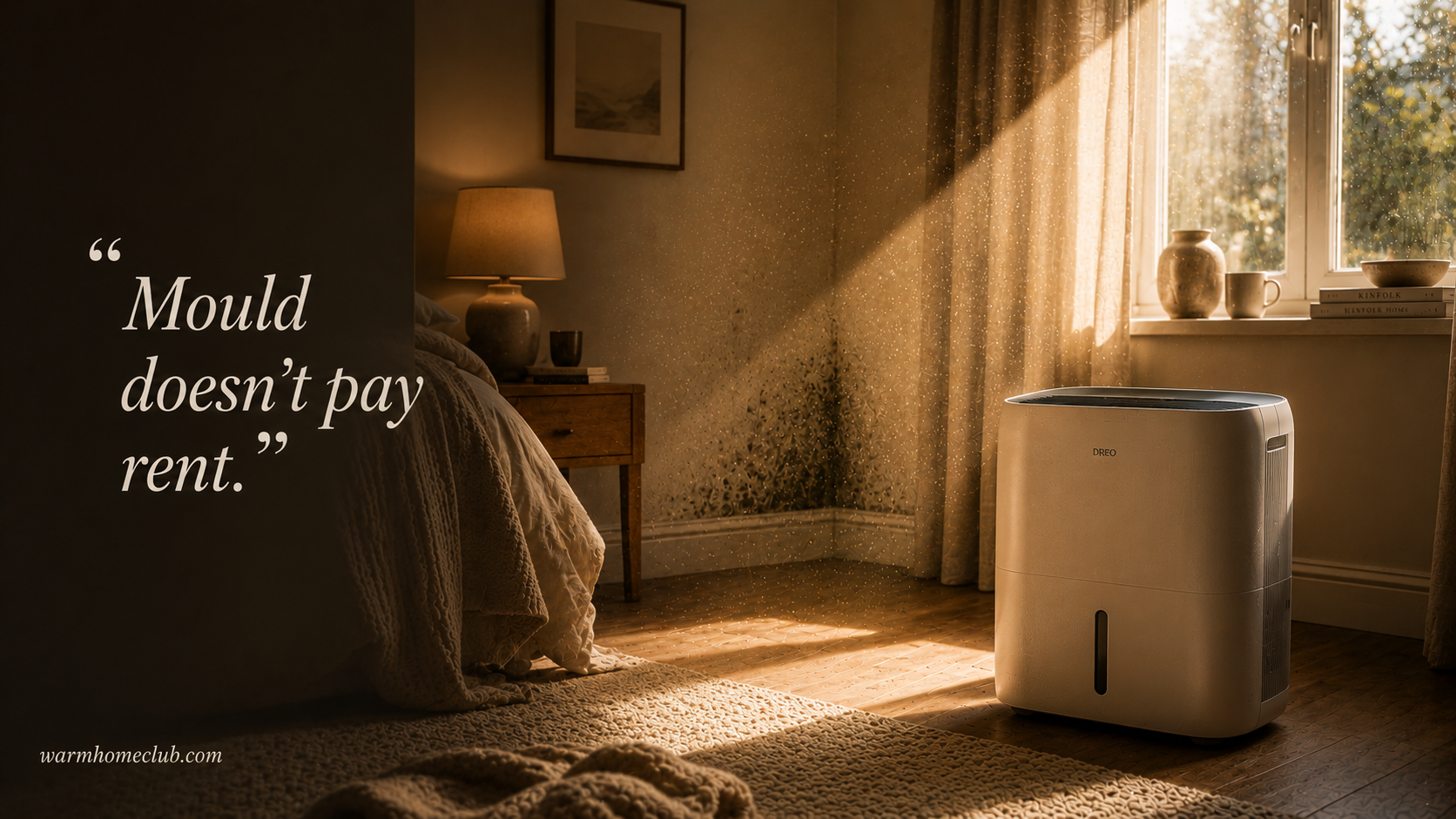
Search for a dehumidifier and the marketing often implies it: drop one in a mouldy room and the problem goes away. The reality is more specific than that. It’s worth understanding properly before you buy one expecting a miracle fix, or dismiss one as useless because it didn’t clear mould that was already there.
A dehumidifier genuinely helps prevent new mould from forming, because it reduces the humidity mould needs to grow. It does not kill or remove mould that has already established itself on a wall, ceiling, or piece of fabric.
These are two different jobs. Mixing them up is the single biggest reason people feel let down by a dehumidifier that’s actually working exactly as intended.
Clean the mould off first, then use a dehumidifier to stop it coming back.
Why humidity matters more than people realise
Mould is a fungus, and like most fungi it needs moisture to grow and spread. Indoor air almost always contains mould spores already. Once humidity rises above around 60%, those spores find genuinely favourable conditions to settle and start growing on a damp surface. Keep humidity consistently below that threshold, and new mould struggles to establish itself, even where spores are present.
How a dehumidifier actually works
A dehumidifier draws in humid air and passes it over a cooling element. Moisture condenses out and collects in a reservoir. The drier air returns to the room. Run one consistently in a room prone to damp, and it keeps humidity below the level mould needs. This genuinely works, and it’s well evidenced.
In the English Housing Survey 2024 to 2025, 31% of households, around 7.7 million, reported an issue with condensation, damp or mould in their home. When surveyors assessed homes for the same survey, serious condensation was the most common type of damp they found, ahead of penetrating damp and rising damp.
What a dehumidifier will not do
Existing mould, the black spots already on a wall, ceiling, or window seal, needs physical removal or a mould-specific cleaning product. A dehumidifier running in the same room won’t lift, dissolve, or kill spores that have already colonised a surface. Reducing humidity stops the mould from spreading further. It also makes conditions less favourable for it to return once removed. But the existing patch itself needs cleaning away first.
What a dehumidifier can and cannot fix
- What you haveBlack spots already on a wall, ceiling or window sealLikely causeMould that has already colonised the surfaceStart hereClean it off with a mould-specific product first
- What you haveA leak, or water actively getting into the roomLikely causeA moisture source a dehumidifier cannot fixStart hereFix the leak before anything else
- What you haveSteamy bathroom or kitchen with poor ventilationLikely causeMoisture with no proper extractionStart hereAdd proper extraction, then dehumidify
- What you haveCondensation from cooking, showering or drying clothes indoorsLikely causeEveryday household moistureStart hereVentilation habits, plus a dehumidifier
- What you haveMould keeps coming back after cleaningLikely causeHumidity still above around 60%Start hereRun a dehumidifier consistently, not occasionally
- What you haveDehumidifier running but another room is still dampLikely causeIt only dries the air immediately around itStart hereMove it into the affected room
The right order to actually solve a mould problem
Clean off existing mould first
Use a proper mould-specific cleaning product on the affected surface. A dehumidifier does nothing for the mould that’s already there.
Protect yourself while you do it. NHS advice is to wear gloves, goggles and a mask, wipe the mould off with a damp cloth and then throw the cloth away, and to clean at least a metre around the visible patch. Mouldy carpets, soft furnishings and ceiling tiles may have to be thrown away rather than cleaned.
Address the source of the moisture
Do this if there’s an obvious one. This might be a leak, poor ventilation in a bathroom or kitchen, or condensation building up on a specific window. A dehumidifier reduces general humidity, but it isn’t a substitute for fixing a genuine leak or adding proper extraction where moisture is actively entering the room.
Run a dehumidifier consistently afterwards
This keeps the room’s humidity below the level mould needs to return. It’s the step that actually prevents a repeat, and the one most people skip once the visible mould is gone. For picks by room size, see our best dehumidifiers for small UK homes guide.
If the underlying cause is genuine condensation from everyday household moisture, cooking, showering, drying clothes indoors, rather than a leak or structural issue, our guide to why your house might be so damp in winter covers the full picture, including ventilation habits that reduce how much moisture builds up in the first place.
When this needs more than a DIY fix
A dehumidifier only deals with moisture that’s already in the air. Government guidance separates condensation from other kinds of damp: penetrating damp, where water gets into the building from outside through a defect; rising damp, where moisture comes up from the ground; and leaks from waste and heating pipes. None of those is a dehumidifier job. They need the building itself fixing.
Take mould more seriously if anyone in your home is more vulnerable to it. The same guidance names people with existing health conditions such as asthma, allergies or COPD, children and young people, older people, and anyone who is bedbound, housebound or has mobility problems. If you think damp and mould is affecting someone’s health, speak to your GP.
If you rent, report damp and mould to your landlord rather than living with it. In England, social housing has been covered by Awaab’s Law since 27 October 2025, which requires landlords to investigate significant damp and mould hazards within 10 working days and to deal with emergency hazards within 24 hours. Citizens Advice can help if you’re not getting anywhere.
Dehumidifiers and mould: your questions answered
Do dehumidifiers actually get rid of mould?
Not existing mould. A dehumidifier reduces the humidity in a room, which helps prevent new mould from forming and stops existing mould from spreading further, but it will not remove or kill mould that has already established itself on a surface. Existing mould needs to be physically cleaned off using a mould-specific product, after which a dehumidifier helps stop it coming back.
What humidity level causes mould to grow?
Mould generally becomes a risk once indoor humidity rises above around 60%. Keeping a room’s humidity consistently below this level makes conditions genuinely unfavourable for mould spores to settle and grow, even though the spores themselves are present in almost all indoor air. A dehumidifier is one of the most effective tools for keeping humidity below this threshold in a room prone to damp.
Should I clean the mould first or run the dehumidifier first?
Clean the existing mould first using a proper mould-specific cleaning product, since a dehumidifier will not remove mould that’s already on a surface. Once the visible mould is cleaned off, running a dehumidifier consistently in that room helps keep humidity low enough to stop it returning, which is the step most people skip once the room looks clean again.
Do dehumidifiers work in large open-plan rooms?
Less effectively than in an enclosed single room. Dehumidifiers pull moisture from the air immediately around them rather than an entire house, so a single unit in a large open-plan kitchen-diner or a house with multiple connected rooms will have a much smaller effect than the same unit in a closed bedroom or bathroom. For larger or open-plan spaces, a higher-capacity dehumidifier or multiple units may be needed.
Is a dehumidifier or an air purifier better for mould?
They work differently and address different parts of the problem. A dehumidifier reduces the moisture in the air that mould needs to grow, tackling the root cause. An air purifier filters mould spores and other allergens out of the air, which can help with the health symptoms of mould exposure but does not address the humidity causing the mould in the first place. For a genuine mould problem, a dehumidifier is the more directly relevant tool, though using both together is reasonable if air quality and allergies are also a concern.
Will a dehumidifier stop mould coming back after I've cleaned it?
Yes, provided it’s run consistently rather than occasionally, and the room doesn’t have an unaddressed source of moisture like a leak or poor ventilation feeding the problem. A dehumidifier keeping humidity below the level mould needs is one of the most effective ways to prevent a cleaned area from developing mould again, but it works best combined with basic ventilation habits rather than as the only line of defence.