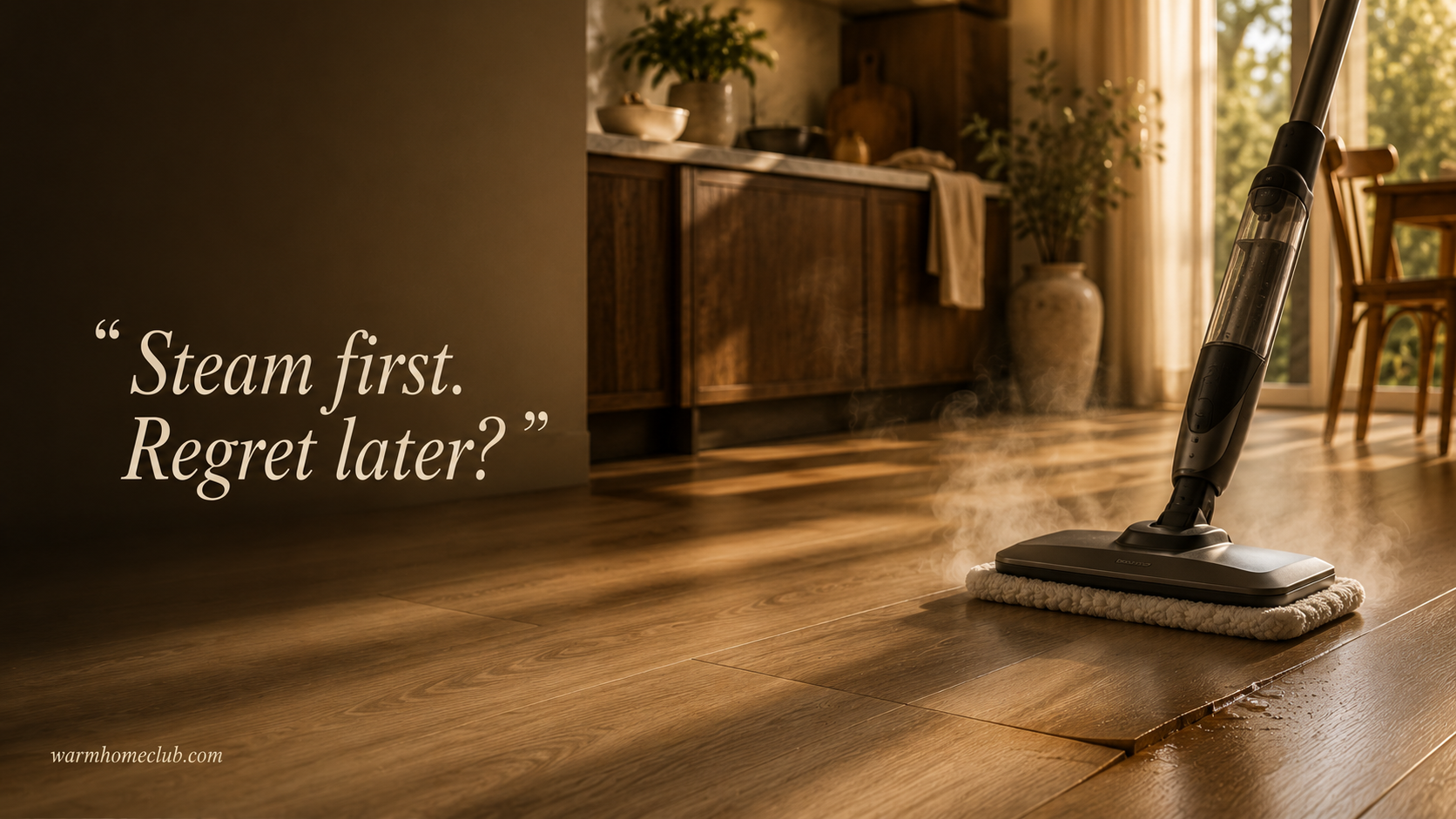
Search for a steam mop and the marketing is confident: works on laminate, works on hardwood, chemical-free deep clean for every surface. Search for laminate flooring care instead, and the tone changes completely. Manufacturers warn that too much water can damage laminate, and the ones that do allow a steam cleaner only allow it on specific water-resistant ranges, with a cloth over the steam openings so the steam never hits the floor directly. Two industries, two very different answers to the same question, and it is worth understanding why before you run a steam mop over your own floor.
One of these industries sells you a steam mop. The other has to honour your floor’s warranty if it fails. That is not a coincidence, and it is the honest starting point for this whole question.
On standard laminate, no. Steam forces moisture into the seams and the fibreboard core, and the damage builds up over time and is rarely reversible.
Some water-resistant ranges from Pergo and Quick-Step do allow a steam cleaner, but only with a cloth covering the steam openings so steam never reaches the floor directly. Check your own floor’s care guide before you try it.
Your flooring's care guide decides whether steam is safe, not the steam mop box.
Why steam actually damages laminate
Laminate flooring is built from a high-density fibreboard core, topped with a printed layer designed to look like wood, sealed under a thin protective coating. The surface coating is genuinely water-resistant. The seams between boards, and the fibreboard core underneath, are not.
Steam does not just sit on the surface the way a quick splash of water might. Heat and pressure actively push moisture into any gap, and laminate seams are exactly that: a gap. Once moisture works its way into the fibreboard core, it can cause the board to swell, warp, or separate at the joint. This does not always happen after one clean. It is a cumulative process, and by the time it becomes visible as bubbling, lifting, or a soft spot underfoot, the damage is usually already done and is rarely reversible.
What manufacturers actually say
This is where the detail matters. Pergo and Quick-Step, two of the biggest laminate brands sold in the UK, both warn that using too much water can damage a laminate floor. Neither gives steam a blanket green light. Both do allow a steam cleaner on their water-resistant ranges, with one condition: an appropriate cloth must cover the steam openings. Pergo’s warranty conditions put it plainly: a steam cleaner is allowed “if there’s no steam directly coming on the laminate.” Even then, Pergo’s allowance applies only to its water-resistant floors with pressed bevels, the grooved edges along each board, not to every Pergo range.
Outside those specific ranges, assume steam is not covered. Pergo’s warranty excludes damage caused by improper maintenance and by inappropriate cleaning products. If you are unsure which range you have, contacting the manufacturer directly is the most reliable way to get a straight answer.
Can you steam your floor?
- Your floorStandard laminateSteam mop?Not recommendedClean it withA barely-damp microfibre mop and a laminate-safe cleaner
- Your floorWater-resistant laminate whose care guide allows steamSteam mop?Only as the guide describes, with a cloth over the steam openingsClean it withYour manufacturer's own method and cleaner
- Your floorWater-resistant laminate with no steam guidanceSteam mop?Assume notClean it withA barely-damp microfibre mop
- Your floorLuxury vinyl, such as Karndean or AmticoSteam mop?No, both brands advise against itClean it withA damp mop and the manufacturer's recommended cleaner
- Your floorSealed tileSteam mop?YesClean it withA steam mop is a good fit
The “waterproof” marketing loophole
This is where most of the genuine confusion comes from. Some newer laminate and engineered wood products are marketed as water-resistant or even waterproof, and it is easy to assume that means steam is fine too. On its own, it does not. Water-resistant means the surface coating handles the occasional spill without immediate damage if you wipe it up promptly. It does not mean the seams or the fibreboard core underneath can withstand sustained heat and pressure being forced into them repeatedly.
Where a manufacturer does allow steam on a water-resistant range, it is on specific terms, with the steam openings covered so the steam never hits the floor directly. If you are ever unsure, the only reliable answer is your specific flooring’s own care documentation, not the marketing on the steam mop box.
If you are going to do it anyway
If your floor is one of the water-resistant ranges whose care guide allows steam, follow that method exactly, including the cloth over the steam openings. That is the only version of steam cleaning laminate that a manufacturer stands behind.
For any other laminate, some owners do use a steam mop regularly without visible problems for years, and it would not be honest to pretend that never happens. If you are going in with your eyes open despite the above, the risk reduces considerably if you use the lowest possible steam setting and keep the mop moving constantly rather than letting it rest in one spot. Test an inconspicuous corner first, and check your warranty documentation before you start, since if something does go wrong, you will not have cover.
What is actually safe instead
For everyday cleaning, a barely-damp flat microfibre mop with a pH-neutral, laminate-specific cleaner is the approach most flooring manufacturers endorse. Spray the cleaner onto the mop pad rather than directly onto the floor, work along the direction of the planks rather than across them, and avoid leaving any standing water, particularly at the seams. A dry microfibre mop for daily dust and grit, with this damp method reserved for a weekly deeper clean, keeps laminate looking good without the moisture risk.


If your home has a genuine mix of flooring, sealed tile in the kitchen and bathroom, laminate in the hallway or bedrooms, a steam mop remains an excellent, safe tool for the tile, just not for the laminate running alongside it. Check any vinyl too: Karndean and Amtico, two of the biggest luxury vinyl brands in the UK, both advise against steam cleaners. Our best steam mops UK guide covers the picks worth buying for those genuinely steam-safe surfaces.
If your laminate is already swelling
Stop steam cleaning it straight away and let the area dry out fully. Do not try to force raised edges back down or sand them flat, since sanding goes straight through the printed layer.
Swollen fibreboard rarely returns to its original shape, so the affected boards usually need replacing. A flooring fitter can often replace individual boards rather than the whole floor, which is where any spare boards left over from fitting become worth keeping. If the damage is widespread, or keeps spreading after you have stopped steaming, get it looked at in case moisture is also coming from underneath.
Steam mops and laminate: your questions answered
Can I use a steam mop on laminate flooring?
Not on standard laminate. The surface coating is water-resistant, but the seams between boards and the fibreboard core underneath are not, and steam can force moisture into these vulnerable points, causing swelling, warping, or joint separation over time. Some water-resistant ranges, including from Pergo and Quick-Step, do allow a steam cleaner, but only with a cloth covering the steam openings. Unless your flooring’s care guide says otherwise, assume steam damage will not be covered by the warranty.
Will using a steam mop void my laminate flooring warranty?
It depends on the floor. Pergo’s warranty excludes damage caused by improper maintenance and inappropriate cleaning products, but allows a steam cleaner on its water-resistant ranges if a cloth covers the steam openings, and Quick-Step takes the same approach. If your floor’s care guide does not allow steam, assume any damage it causes will not be covered. Check your specific flooring’s care and warranty documentation to confirm.
Is waterproof laminate safe for steam mopping?
Only on the manufacturer’s terms. Waterproof or water-resistant laminate is designed to handle occasional spills without immediate surface damage, but this does not mean the seams or the fibreboard core underneath can withstand sustained heat and pressure being forced into them repeatedly. Pergo and Quick-Step allow a steam cleaner on their water-resistant ranges, but only with a cloth covering the steam openings so steam never hits the floor directly. Water-resistant is not the same claim as steam-proof, and it is worth checking your specific flooring’s documentation rather than assuming.
What does steam damage on laminate actually look like?
Steam damage typically appears as swelling or warping along the seams between boards, bubbling or lifting of the surface layer, or a soft, spongy feeling underfoot in the affected area. It does not always appear immediately after one clean. Damage from repeated steam exposure often builds up gradually and can take weeks to become visibly noticeable, by which point the affected boards usually need replacing rather than repairing.
What is the safest way to clean laminate floors?
A dry microfibre mop for daily dust and grit removal, combined with a barely-damp flat microfibre mop and a pH-neutral, laminate-specific cleaner for a weekly deeper clean, is the method most manufacturers actually recommend. Spray the cleaner onto the mop pad rather than the floor itself, work in the direction of the boards, and avoid leaving standing water anywhere, particularly at the seams between planks. If your manufacturer makes its own cleaner, use that.
Can I steam mop tile or vinyl floors safely?
Sealed tile, yes. It does not have the seam and core vulnerability that laminate does, and steam mopping is a genuinely safe, effective method for it. Vinyl is different: Karndean and Amtico, two of the biggest luxury vinyl brands in the UK, both advise against steam cleaners, so check your own vinyl’s care guide first. If your home has a mix of flooring types, a steam mop remains a good choice for sealed tile while a damp microfibre mop handles laminate and vinyl separately.